
One of my long-time clients used to apologize for her hair before she even sat down in my chair. Fine, flat, see-through at the part, she called it. The day we cut her a shag, she watched the layers fall and said, for the first time, that it looked like she had more hair. She did not. It just finally looked like she did.
That is the whole promise of a shag on thin hair: it makes less look like a choice. The layers and texture trick the eye into reading fullness, and the styling takes minutes. Here is how the cut does it, who it suits, and how to keep fine hair full between salon visits.
The Thin-Hair Shag In Short
- A shag fakes volume on thin hair by removing weight and adding layered texture.
- Shorter, choppier layers look fuller than long, one-length hair that drags flat.
- Volumizing mousse, dry texture spray, and a root-lift blow-dry do most of the work.
- Trim every six to eight weeks, around $50 to $90, to keep the layers crisp.
Why A Shag Works For Thin Hair

Thin hair has one enemy above all: weight. Long, all-one-length hair hangs straight down and shows every gap, especially at the part and the crown.
A shag flips that. By cutting layers, it removes the weight dragging your hair flat and redistributes what you have into shape and lift.
The result looks fuller with no product, because the eye takes texture and movement for density. It is the most volume you can build with scissors alone. The classic shag haircut is the foundation for all of it.

The Shag’s Comeback

The shag never really disappeared, but it is having a real moment again, and thin-haired clients are driving a lot of it. People are tired of flat, lifeless styles that need an hour of backcombing to look like anything.
- It looks current without heavy daily styling
- It suits fine hair better than a blunt cut
- It works from short crops to long layers
Good to Know
Fine hair and thin hair are not the same thing. Fine describes the width of each strand, while thin describes how many you have. A shag helps both by maximizing the volume of whatever you are working with.
How Shags Add Body To Thin Hair

The body comes from a few moves working together. Layers break up the solid weight that flattens fine hair.
Texture at the ends keeps strands from clumping into see-through sections. And crown lift, built into the cut, raises hair off the scalp where thin hair collapses first.
Stack those three and even very fine hair looks like it has body it does not technically have. That illusion is the entire point of the cut.
The Cutting Technique For Thin Hair

For the curious, here is what a good stylist actually does. They keep the bulk of your length but cut internal layers to remove weight from underneath.
Cut Dry To See The Truth
Then they point-cut the ends, slicing in at an angle so the tips taper and look soft rather than thin and stringy.
I cut fine hair dry in my chair, or at least finish it dry, because that is the only way to see how thin hair really falls and where it needs lift. It rewards an experienced hand.
👍Why It Works For Thin Hair
- +Fakes volume with no product
- +Looks current and low-effort
- +Flatters fine hair better than a blunt cut
👎Keep In Mind
- –Needs a trim every six to eight weeks
- –Very long fine hair stays hard to volumize
- –Heavy products undo the effect
The Shag For Your Face Shape

Layer placement flatters your face and adds volume where you want it. Where the pieces start makes all the difference.
- Oval: almost any version works, so add crown layers for height
- Round: longer face-framing pieces lengthen and slim
- Square: soft, feathered layers ease a strong jaw
Strategic Layers For Volume

Not all layers help thin hair, but strategic layers do. The goal is to remove weight without taking so much that the ends go wispy. Shorter layers at the crown create lift, while longer pieces keep the length you want. Done right, the hair stands away from the head a little, which is exactly what the eye takes for fullness.
- Crown layers for lift off the scalp
- Longer lower layers to keep your length
- Soft, tapered ends so nothing looks stringy
“The first thing I tell thin-haired clients is to stop conditioning their roots. Nine times out of ten, that one change adds more visible volume than any product I could sell them.”
Where The Volume Comes From

It helps to know the mechanics, because clients ask me this constantly. Visual volume on thin hair comes from three places, and a shag hits all of them: less weight, more texture, and lift at the root. None of it adds actual hair, but together they change what your hair looks like in the mirror and in photos.
- Less weight so hair stops collapsing flat
- More texture so strands separate and look denser
- Root lift so the crown does not fall flat
Maintenance For A Thin-Hair Shag

A shag on thin hair lives and dies by its trims, even more than on thick hair. The layers lose their shape quickly, and once they grow out the volume goes with them.
Wash Smart, Too
Plan a reshape every couple of months, around $50 to $90, and ask for just a refresh of the layers and ends.
Keep conditioner on the mid-lengths and ends only. Conditioner on the roots flattens fine hair faster than anything else, while a volumizing shampoo at the scalp keeps it lifted.
Stylist Tip
Blast your roots with a cool shot from the dryer while they are still slightly damp, head flipped over. Cool air sets the lift in place, so your crown stays up all day instead of falling by noon.
Timeless Shag Inspiration

The beauty of the shag is that it has fifty years of references to pull from, and plenty of them suit thin hair. You do not need a famous name, just the right shape for your texture.
Save a few photos that match your length and density, ideally of fine hair like yours, so your stylist can show you what is realistic.
- A short, choppy shag for maximum lift
- A mid-length shag with curtain bangs
- A long shag with heavy internal layers
The Risks Of A DIY Shag

I understand the temptation to trim layers at home between salon visits, but on thin hair the margin for error is tiny. One heavy snip in the wrong place leaves a see-through gap that takes months to grow back.
If you must tidy something, stick to the very tips and go tiny. For anything structural, this is a cut worth paying a professional for.
- Thin hair shows mistakes instantly
- Layers cut too short look wispy
- Leave the shaping to someone who cuts fine hair
The Products That Actually Help

Thin hair is picky about product, and the wrong one undoes the cut. Heavy creams and oils flatten everything, so the kit stays light.
A volumizing mousse at the roots and a dry texture spray through the lengths do most of the lifting. A little dry shampoo revives day-two volume.
- Volumizing mousse on damp roots
- Dry texture spray for grip and lift
- Dry shampoo to stretch volume between washes
Bangs For A Thin-Hair Shag

Bangs can be a thin-hair secret weapon, since they gather hair at the front and draw the eye up. Curtain bangs are the easiest, blending into the face-framing layers.
Steer clear of a heavy, blunt fringe if your hair is very fine, since it can look sparse. Wispy or curtain styles fake more density. Browse more curtain bangs for ideas.
- Curtain bangs for soft, blended fullness
- A wispy fringe for fine hair
- Trim the fringe every couple of weeks
Ombre And Highlights For Depth
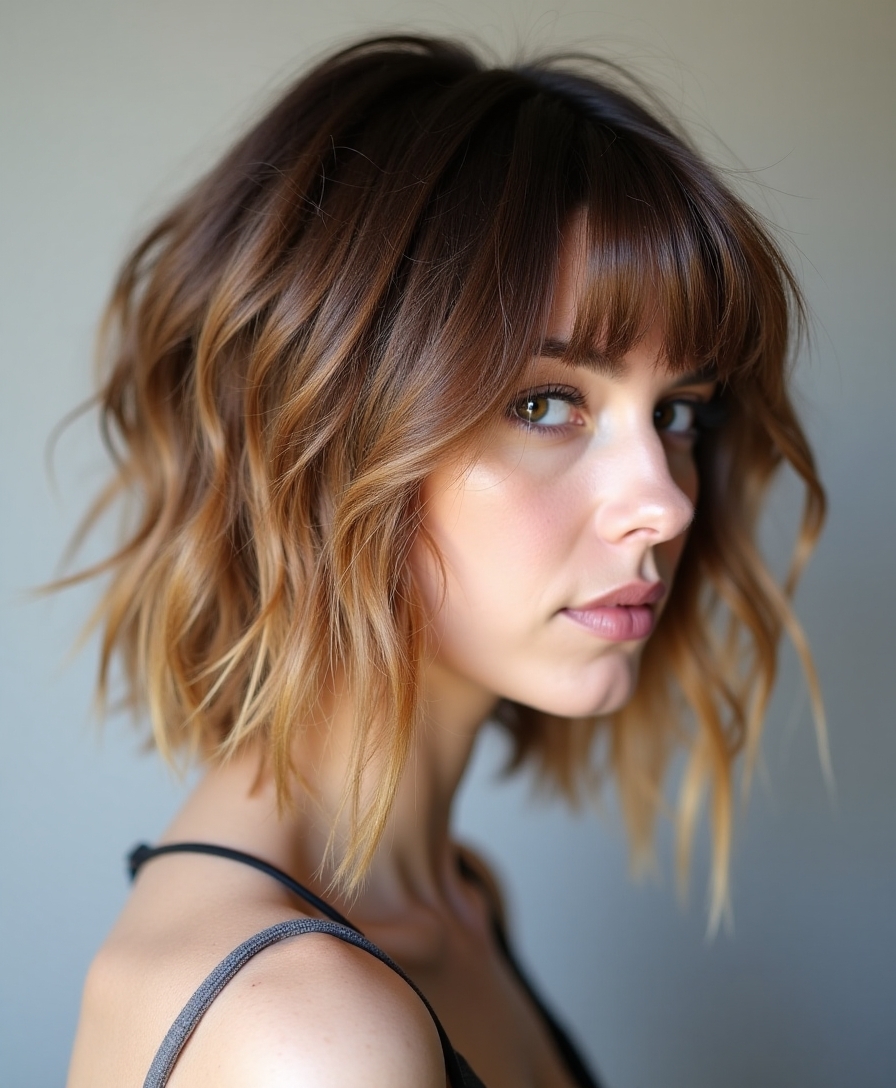
Color is a quiet trick for faking thickness. Flat, solid color makes thin hair look even flatter, while dimension creates the illusion of layers and depth.
Why Dimension Reads Fuller
Ombre and fine highlights add shadows and brightness that make hair look fuller. A slightly darker root, in particular, makes the crown look denser.
The eye sees contrast as texture, and texture as volume. That is why a balayage or ombre often does as much for thin hair as the cut. For a lighter version, see the blonde shag.
The Short Shag For Bold Volume

If you want the most volume for the least effort, go short. A short shag is one of the best haircuts for fine hair, because shorter hair simply holds lift better than long hair fighting gravity. When a fine-haired client wants fast volume, this is usually my first suggestion.
- Choppy crown layers for instant height
- A short length that resists going flat
- Wash-and-go styling with a little texture spray
Easy Volume, Every Day

The everyday routine for a thin-hair shag is short. Flip your head upside down, rough-dry the roots, and let the cut do the rest.
A thirty-second blast at the roots with your dryer builds lift that lasts all day, and a quick scrunch of texture spray sets it. No round brush or hour of styling required.
A Long, Layered Shag

You can keep length with thin hair, as long as the layering is aggressive enough. A long shag without enough internal layers just hangs flat and stringy.
Make Long Length Work
The fix is heavy internal layering that removes weight while keeping the lengths you love. Face-framing pieces then add movement up top.
Be realistic, though: very fine, very long hair is the hardest combination to give volume. If your hair is sparse, a mid-length shag will always look fuller. See more long layered options.
Textured Volume That Adapts

Texture is the thin-hair shag’s best friend, and you can build it with the cut or with a little outside help.
A light perm or a few rollers add bend that makes fine hair look thicker. Even air-drying with a curl cream gives straight, thin hair more grip and body than a poker-straight blow-dry.
However you add it, texture stops strands from clumping into flat, see-through sections, which is what makes thin hair look thin in the first place.
Maximizing Volume

For the fullest possible look, stack the tricks instead of leaning on one. The cut, the color, and the styling each add a layer of fake density.
Pair a layered shag with dimensional color and a volumizing routine, and the effect compounds. This is how stylists make very fine hair look truly full on camera.
No single step does it alone. Combined, they turn thin hair into the fullest version of itself.
More Than A Haircut

For a lot of thin-haired clients, the right shag is more than a style change. Years of feeling self-conscious about a flat part or a thin ponytail add up.
The Confidence Part
Walking out with hair that finally looks full does something for how you carry yourself. I have watched it happen more times than I can count.
It is not vanity; it is relief. A cut that works with your hair, instead of exposing its thinness, is worth finding the right stylist for.
Common Mistakes to Avoid
A few habits quietly sabotage a thin-hair shag. Putting conditioner on the roots is the biggest, since it weighs down exactly where you need lift, so keep it on the ends. Skipping trims is next, because grown-out layers lose the volume that made the cut work.
On the styling side, heavy products and a poker-straight blow-dry both flatten fine hair. Go light on product, add texture, and dry for lift. Get those right and the cut keeps its fullness for weeks.
Thin-Hair Shag Questions, Answered
?Does a shag really make thin hair look thicker?
Yes, visually. It removes weight, adds layered texture, and builds lift at the crown, all of which make the eye read more fullness. It does not add hair, but it makes what you have look noticeably denser.
?What length of shag is best for fine hair?
Short to mid-length usually wins, because shorter hair holds lift better than long hair pulled down by gravity. You can keep length, but it needs heavy internal layering to avoid looking flat and stringy.
?How do I style a thin-hair shag for the most volume?
Rough-dry the roots upside down, then scrunch in a dry texture spray. Keep conditioner off the roots, use a volumizing mousse, and skip heavy creams that flatten fine hair.
Less Hair, More Confidence
Thin hair is not a problem to hide; it is just hair that does better with the right cut. A shag gives fine, flat hair shape, texture, and lift, and it asks for very little in return. The fullness is an illusion, but it is a convincing one.
If you have spent years apologizing for your hair, this is the cut worth trying. Bring a stylist who cuts fine hair a photo that matches your texture, and ask how layers could work for you.
Where to Next