

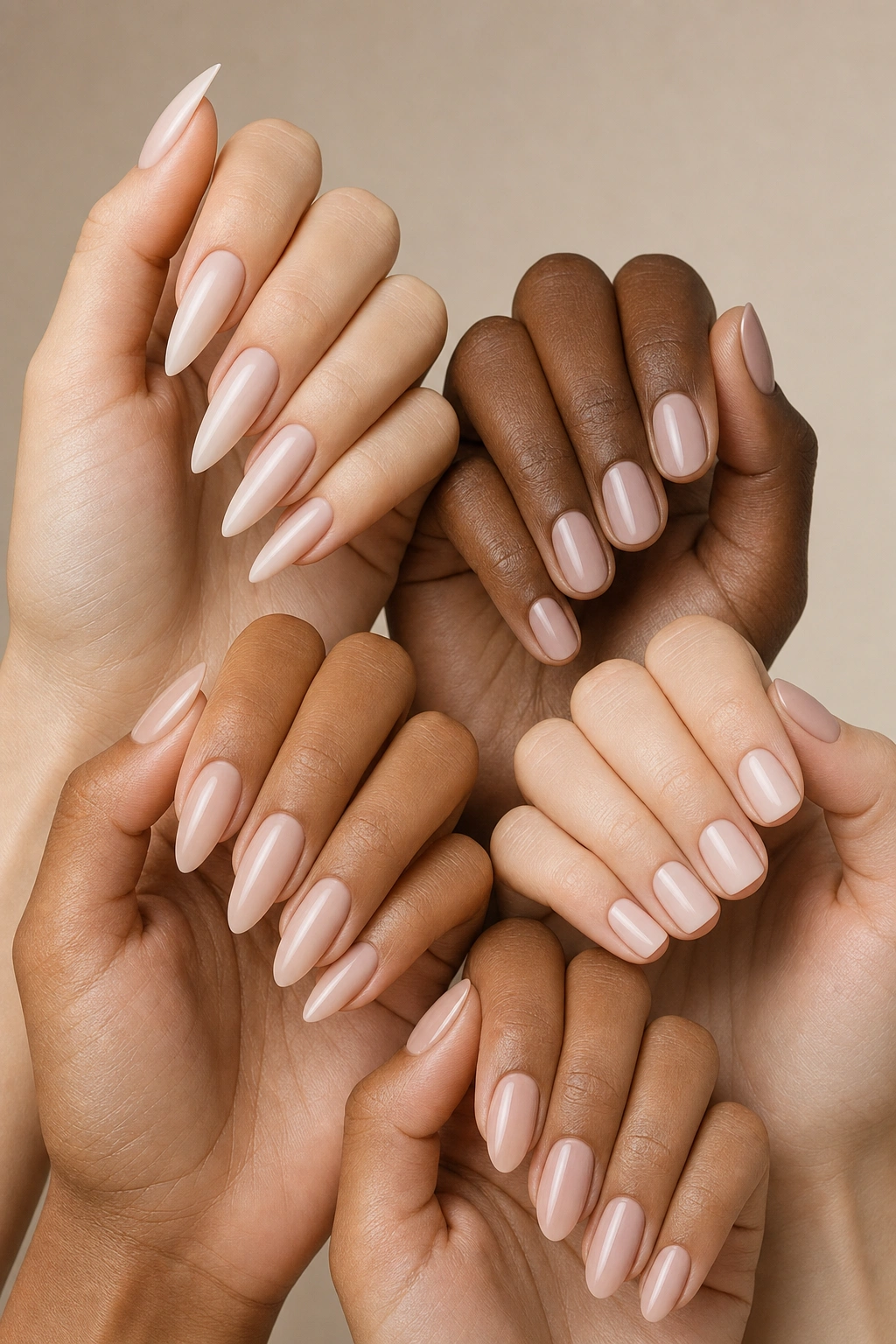
The right nail shape is less about what is trending and more about your fingers, your nails, and how hard your hands work. This quick quiz reads all three, then hands you a shape that actually fits, plus a set of nail looks built for it.
How Your Nail Shape Is Actually Decided
Most nail shape advice starts with what looks pretty in a photo. At the nail desk, I start somewhere far less glamorous: your fingers, your nail beds, and what your hands do all day. Those three things decide whether a shape lasts a week or chips by Tuesday.
Two factors matter most. The first is your nail bed shape: a long, narrow bed carries length and points easily, while a short or wide bed looks best with shapes that either soften the corners or gently elongate. The second is your natural nail strength. If your nails peel or snap the moment they grow, a long pointed shape will only frustrate you unless you commit to extensions.
Everything else, the color, the art, the trend you saw online, comes after. Get the shape right for your hands first, and the looks fall into place.
The 7 Nail Shapes, Quickly
Before you take the quiz, here is the short version so your result makes sense. There are seven shapes worth knowing, and they sit on a simple scale from low-effort to high-drama.
Round follows your fingertip and stays short, the easiest to live in. Squoval is a square with softened corners, the everyday all-rounder. Square keeps straight sides and a flat tip for clean strength. Oval curves to a rounded point and flatters wide beds. Almond tapers to a soft peak and elongates beautifully. Coffin, also called ballerina, runs long with a flat tapered tip for nail art. Stiletto ends in a sharp point and makes the boldest statement.
None is better than another. The best shape is simply the one that matches your nails and your week, which is exactly what the quiz below sorts out.
What Nail Shape Suits You?
Twelve quick questions, one shape, and looks to copy. No email needed to see your teaser.
Picking a Shape That Survives Your Real Life
The prettiest shape in the world is useless if it cannot survive your Tuesday. This is where I see people go wrong most often: they pick a coffin or stiletto for the look, then peel it off two weeks later because the upkeep collided with their life.
Match the shape to your hands honestly. If you type all day, garden, or chase a toddler, lean toward round, squoval, or square, which spread pressure and resist snapping. If your nails rarely take a hit and you enjoy a salon visit, the longer almond, coffin, and stiletto shapes reward the attention. There is no wrong answer, only an honest one.
Length is the other quiet decider. Shorter shapes forgive almost everything; longer ones magnify every chip and every bit of regrowth at the cuticle. Choose the length you will actually maintain, not the one you admire on someone else.
Nail Shape and Nail Health
A shape should work with your nails, not against them, and that goes for every skin tone and nail type. Brittle, peeling, or ridged nails are common and rarely a sign of anything serious, but they do change which shapes hold up. If yours are fragile, a softer shape with a little builder gel support will always outlast a long point.
A few habits protect any shape: file in one direction rather than sawing back and forth, push back cuticles gently instead of cutting them, and keep a thin layer of oil on the nail and the skin around it. Hydrated nails flex instead of snapping. If you notice persistent splitting, lifting, or color changes that do not grow out, that is a conversation for a professional rather than a filing tweak.
Getting the Shape Right, at the Salon or at Home
Once you know your shape, getting it cleanly is mostly about communication and the right file. At the salon, name your shape and bring a reference photo; coffin and stiletto especially depend on a tech who balances both sides evenly, since a crooked taper is the giveaway. Ask them to keep the length where you said, because it always grows in the chair.
At home, a good 180-grit file and a little patience handle the softer shapes. Round, oval, and squoval are very beginner-friendly: file the sides, shape the tip, and stop before you overdo it. Save the long, tapered shapes for a professional, where the structure of the extension matters as much as the filing. Whichever route you take, finish with a glossy top coat and a drop of oil, and your shape will read intentional instead of accidental.
Frequently Asked Questions
How do I know my natural nail shape?
Look at the base of your nail where it meets the cuticle. That curve is your natural shape, and the most flattering filed shape usually echoes it. A rounded base loves round or oval; a straighter, squarer base wears square and squoval well. Working with your natural curve rather than against it is what keeps a shape from looking forced.
Which nail shape is the strongest?
On natural nails, round and squoval are the most durable because there is no long tip or sharp corner to catch and snap. Square is strong too on longer beds. The pointed and long shapes, almond, coffin, and stiletto, are weaker at the tip and usually need acrylic or hard gel for real staying power.
What nail shape is best for short or wide fingers?
Almond and oval are your friends. Their tapered or curved sides draw the eye lengthwise and visually slim a wide nail bed, which makes shorter fingers look longer. Skip a wide, blunt square if your beds are short, since the straight lines can read a little stubby.
Which nail shape lasts the longest between appointments?
Round and square hold up best, often three to four weeks before they look grown out, because their durability and shorter length hide regrowth. Coffin and stiletto show cuticle regrowth fastest and usually need a fill every two to three weeks to stay sharp.
Can I change my nail shape at home?
Yes, for the softer shapes. Round, oval, and squoval are all achievable with a 180-grit file and a steady hand: file the sides, shape the tip, and stop early. Long tapered shapes like coffin and stiletto are best left to a professional, since they rely on extension structure as much as filing.
Does nail shape work the same on every skin tone?
Shape itself suits everyone equally; it is about your fingers and nails, not your skin tone. What does shift is color, and that is worth getting right. Deep, rich skin tones often look striking in saturated reds, bright chrome, and warm metallics, while the right nude is the one that flatters your own undertone rather than a single default shade.
What is the most low-maintenance nail shape?
Round, hands down. It stays short, follows your fingertip, and has no tip to snap, so it survives busy hands and grows out gracefully. A weekly clear coat is often all it needs, which makes it the easiest shape to keep looking tidy with almost no time or cost.
